Tinnitus TherapyIt's Not Just a Ringing in Your Ears
It's Not Just a Ringing in Your Ears
It's an Alarm System Stuck on "On".
Stop the noise from controlling your mood, your sleep, and your life. Let’s not fight the Tinnitus. Let’s reprogram your answers.
The Neuroscience
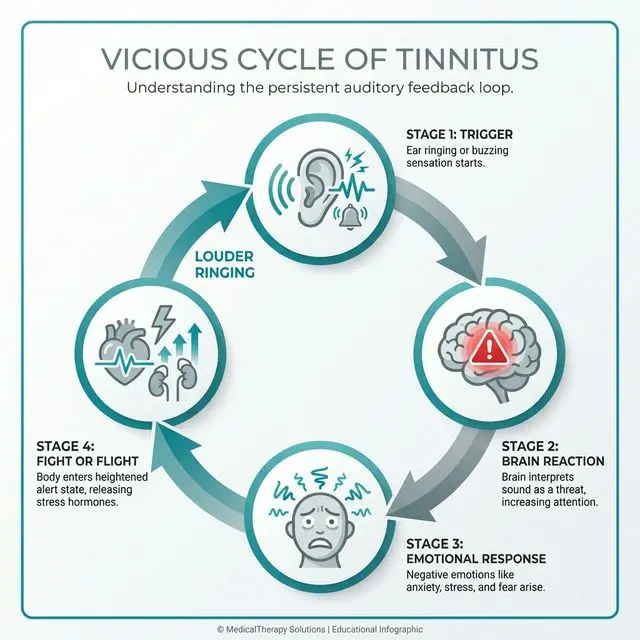
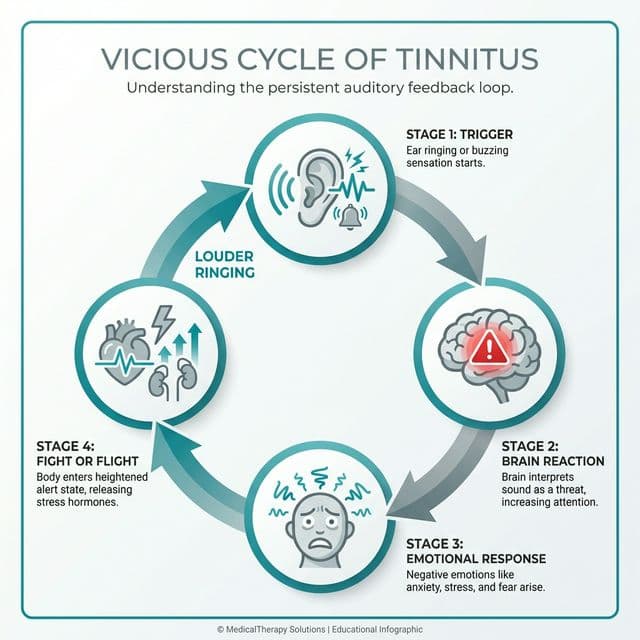
The Vicious Cycle
Tinnitus isn't just in your ear; it's a loop between your ear, your emotional brain (limbic system), and your autonomic nervous system. This fight is hard because it is natural for us to focus our attention on signals that are annoying, disturbing or distressing. Habituation means to learn to ignore: let Tinnitus fade in the background. But this is only possible if you can stop focusing on it.
- 1. The Trigger
- Tinnitus or a change in Tinnitus (loudness, pitch, location)
- 2. The Evaluation
- The brain's amygdala labels this signal as a disturbance, distress or annoyance.
- 3. The Reaction
- The initial reaction triggers negative thoughts (“What’s happening? What’s wrong with me? Why can’t this noise just stop? I am going mad!”) and these increase the level of negative emotions: stress, anxiety, frustration.
- 4. The Reinforcement
- Attention locks onto the sound, teaching the brain to monitor it constantly as the cause of all these distress. More negative thoughts and emotions keep the cycle running.
Habituation to Tinnitus: A structured, evidence-based CBT protocol
- 1. Awareness & Demystification
- Understanding your Tinnitus: what Tinnitus is and what it is not. Your reaction is valid and you can find a way forward.
- 2. Neutralization
- Using CBT tools to upskill you to learn you can manage.
- 3. Habituation
- The goal. The moment you realize you haven't heard the sound all morning, even though it was there.